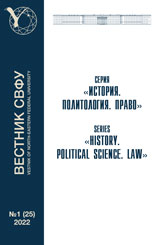
Title: Вестник Северо-Восточного федерального университета имени М. К. Аммосова. Vestnik of North-Eastern Federal University. Серия «Общественные науки. Social science»
Founder and publisher of the Series: Federal State Autonomous Educational Institution of Higher Professional Education “M. K. Ammosov North-Eastern Federal University”.
The periodical is registered as an online publication by the Federal Service for Supervision in the Sphere of Telecom, Information Technologies and Mass Communications (Roskomnadzor):
Certificate of registration as a media organization: ЭЛ No.ФС 77-71436 of 26 October 2017
Domain name: IPPSVFU.RU
Distribution form: сетевое издание.
Distribution area: Russian Federation, other countries.
The periodical is included in the Russian Science Citation Index (RSCI) database.
The periodical published articles in the following academic fields:
5.1. Law
5.1.2. Public Law (State Law) Sciences
5.1.3. Private Law (Civil) Sciences
5.1.4. Criminal Law Sciences
5.5. Political Science
5.5.2. Political institutions, processes, technologies
5.6. Historical Sciences
5.6.1. Russian History
Current issue
LAW
This article examines the potential for integrating modern digital technologies for environmental monitoring and the prevention of illegal environmental acts. In this paper, the author attempts to assess the prospects for using digital technologies, as well as the challenges associated with their implementation in environmental protection, taking into account current conditions.
The article examines the investigator’s discretion when choosing a preventive measure in the form of bail in terms of the investigator’s choice of the most appropriate and justified course of action for making the optimal decision on the application of this preventive measure, provided and limited by law and procedural powers. The degree of freedom of such choice is determined by the limits of the investigator’s discretion. As such limits (boundaries of what is permitted), the author examines the legal regulation of general and special grounds for choosing bail, and the procedure for its application established by criminal procedural law. They are studied in conjunction with the positions of scientists and established practical experience in determining the scope of application of the said preventive measure, establishing the subject, the amount of bail, and other issues. The conclusion highlights areas for improving the practice of choosing bail, which may influence the choice and relevance of this preventive measure to the investigator.
In this article, the authors examine the problem of the lack of a specific list of grounds for excluding a member of a company from the company in the legislation, as well as the problem of the lack of clear criteria in the legislation for a gross violation of the LLC member’s duties, which makes it impossible for the company to operate or significantly complicates it. The author’s goal is to study the gaps in legal regulation, analyze the positions of scientists and judicial practice. The article analyzes the judicial practice of the highest courts, which distinguishes whether a particular action or inaction by a participant is a basis for exclusion, and also establishes which circumstances will serve as a basis for denying a claim to exclude a participant from the company.
This article examines the dictation, a form of legal education that has become popular over the past 10 years. Dictations are conducted in various fields: history, geography, law, language, ethnology, cultural studies, pedagogy, etc. However, if the scale of their implementation allows for a high level of social engagement and knowledge on a specific topic, and introduces students to specific sources of information to gain new, accurate understanding, then the results allow us to evaluate the effectiveness of preventive and educational activities in expanding legal awareness. With this in mind, the article examines the distinctive features of a dictation with legal significance. The subject of this study is the 1st Republican Anti-Terrorism Dictation, conducted at the M.K. Ammosov North-Eastern Federal University (October 2-10, 2025). The aim of the dictation was to foster a strong rejection of the ideology of terrorism and extremism among young people and to instill spiritual and moral values. In this regard, it is considered as one of the possible forms of crime prevention and legal awareness, education, and public awareness.
The article examines the systemic legal problems of licensing medical activities in the Russian Federation. The purpose of the study is to identify key defects in the current licensing model and develop specific proposals for its improvement. To achieve the goal, the tasks of analyzing the regulatory framework, classifying problems, and studying judicial practice are solved. The methodological basis was formed by formal-legal, comparative legal methods and the method of analysis of judicial practice. The main problems are identified and analyzed: fragmentation and redundancy of requirements, formal nature of inspections, legal vacuum in the regulation of telemedicine. The scientific novelty lies in the justification of a comprehensive approach to reform, the key elements of which are: the transition to a risk-oriented model, full digitalization of procedures (“electronic licensing file”) and the development of specialized requirements for services using telemedicine technologies. The results of the study can be used in legislative activities to improve licensing legislation, as well as in the practical work of supervisory authorities and medical organizations.
The author identifies the problem of latency of digital crime as one of the key barriers to ensuring cybersecurity in modern conditions. The article analyzes specific factors that contribute to the concealment of crimes in the digital environment, pays attention to the classification of types of latency in relation to the IT sphere, and identifies the characteristic features of digital crime that cause its high latency.
The article discusses the concept of “information legal space”, as well as the perception of this term by legal science. The authors conclude that at present, the definition of this concept as an infrastructure providing access to legal information for legal entities is based on the context of its application in losing relevance policy documents, the development of which was carried out in certain historical conditions: during the period of informatization (the process of creating optimal conditions for meeting information needs) and the formation of the Russian Federation as a state. In turn, the concept of information space, which exists and is applicable in relevant strategic and program documents, is very broad, given to it by digitalization, the process of integrating information and communication technologies into public relations. The authors conclude that a different approach to defining the concept is currently needed, which would meet the requirements of modern society: the information legal space is a part of the general information space, sanctioned (that is, approved, recognized as legitimate) and regulated by the state. According to the authors, in this way, legal science will be able to study and analyze individual institutions – the official websites of government agencies and local governments, state information systems – as a single integrated object, which will allow for a deeper exploration of a new type of interaction between citizens and the state – interaction using information and communication technologies.
This article analyzes the impact of digitalization on investigators’ procedural work and the changes it brings to the work of relevant agencies. The research problem centers on the lack of uniformity in the implementation of new tools and technologies in criminal proceedings, which hinders the development of sustainable mechanisms for handling digital data and complicates the optimization of investigative activities. The aim of the study is to identify the real impact of digitalization on investigators’ work and to determine the advantages and limitations of this transformation. The study’s materials include regulatory legal acts, scientific publications, and empirical data obtained through a survey of 14 investigators from the Investigative Committee of the Russian Federation. The methodological basis consists of document analysis, a comparative legal approach, and a qualitative and quantitative analysis of the survey results. It has been established that digitalization is actively penetrating the core elements of investigator work– evidence recording, digital trace analysis, document management, and interdepartmental communication. However, this development is uneven and is accompanied by technical glitches, fragmented legal regulation, insufficient competencies, and the absence of a unified digital platform.
Classification is a complex and multifaceted process used by all sciences. Classification is a system of subordinate concepts (classes of objects) in any field of knowledge or human activity, often presented in various forms of diagrams (tables) and used as a means of establishing relationships between these concepts or classes of objects, as well as for precise orientation in the diversity of concepts or corresponding objects. Natural resources represent one of the fundamental values of the Russian Federation, aimed at satisfying spiritual and physical needs. Classification of natural resources is necessary for better orientation in the diversity of research objects and a more in-depth analysis of the subject. There are many approaches to the classification of natural resources, due to the diversity of sciences studying this subject. One of the sciences studying natural resources is jurisprudence. Jurisprudence, in turn, studies the legal relationships (use, protection, and reproduction) associated with natural resources. Due to the wide variety of natural resources and the legal relationships associated with their use, there is a need to expand the classification for a more in-depth study and to define their place in jurisprudence. The purpose of this work is to develop a legal classification of natural resources. To achieve this scientific goal, an analysis of the civil, criminal, and administrative legislation of the Russian Federation is conducted. The obtained research results can form the basis for a more in-depth scientific study of natural resources, depending on the legal act regulating legal relationships with them.
POLITICAL SCIENCE
This article provides a comprehensive analysis of the institution of volunteering at the regional level. In recent years, Russia has seen various measures of state support for volunteer organizations, financial assistance, and more. The COVID-19 pandemic has become an important factor in promoting mutual assistance among the population, which has contributed to the development of civil society. In terms of legal framework, various concepts for the development of volunteering in Russia have been adopted, as well as federal and regional laws, official statistics, and reports from volunteer organizations. The article uses the example of the Sakha Republic (Yakutia) to study the institutional mechanisms and practices of integrating volunteerism in a multi-ethnic region with unique geographical characteristics. The aim of the study is to identify and analyze the specifics of the institution of volunteerism in the Sakha Republic (Yakutia). The methodological framework of the study is based on a systematic approach and the theory of institutionalism, which considers volunteerism as a social institution.
This article examines the role of student research organizations at the M.K. Ammosov North-Eastern Federal University (hereinafter referred to as NEFU) in the context of youth policy. The relevance of this work is determined by state policy priorities aimed at patriotic education of youth and the creation of favorable conditions for the self-realization of the younger generation, which requires studying the agents of youth policy. In this regard, the study aims to identify the role of student research organizations as agents of youth policy in the overall Strategy for the Implementation of Youth Policy using NEFU as an example. The methodological basis of the study is a structural-functional approach combined with the method of substantive content analysis and data synthesis. The main materials of the study are two fundamental documents of youth policy: the Strategy for the Implementation of Youth Policy through 2030 and the Federal Law “On Youth Policy in the Russian Federation”, as well as materials from the official website of NEFU. The results of the study showed that student research organizations are an effective tool for implementing youth policy at the micro level within the university and its departments. This paper systematizes the forms and functions of student research organizations, as well as the types and levels of their activities. The theoretical significance of this work lies in conceptualizing student research organizations as a specific agent of youth policy. The practical value of this work lies in the possibility of using the research findings for a comparative analysis of student organization activities across different universities, as well as for developing mechanisms to improve the effectiveness of these organizations.
This paper addresses the current issue of gender aspects in leadership among students, specifically examining the characteristics of female leadership in the student governance system. Understanding these specific features can help identify both the benefits and challenges faced by female students seeking active involvement in social activities, and develop effective strategies to support their potential. The goal of this study is to identify the characteristics of women’s leadership within student government at the Northeastern Federal University. The research employs a range of methods, including statistical analysis and a sociological survey. Statistical analysis allows for measuring the proportion of female leaders, providing an objective view of the extent of female representation in leadership positions. A sociological survey assists in measuring attitudes and opinions regarding what factors may impede the participation of students of a particular gender. The article presents the outcomes of an analysis of the gender aspect of student government at NEFU. It has been revealed that women are well-represented in leadership positions, exhibiting a high level of organizational abilities, sociability, and teamwork-orientedness. The study uncovers a number of essential characteristics of female leadership in this setting, as well as analyses stereotypes and societal expectations that impact the perception and performance of female leaders. Particular attention is given to identifying specific challenges faced by female leaders (e.g., balancing educational and social commitments, overcoming gender-based biases, and matters of self-representation). The findings of the research can be utilized in the development and enhancement of programs designed to support and promote women’s leadership within student organizations. Additionally, they can contribute to the creation of educational and training initiatives aimed at enhancing the effectiveness of student governance in general.
HISTORICAL SCIENCES
In 2025, the 80th anniversary of the victory in the Great Patriotic War is celebrated. Publications about the history of the Great Patriotic War are always relevant: every year certain unknown documents are found, and the information is clarified. There are many studies about education during the war, but there is no information about the history of general educational institutions in Yakutia during the war era. The purpose of this article is to identify the main features of the work of schools in the republic during the war. During the war, educational institutions of the republic had to work in difficult conditions. The paper analyzes data on the number of teachers during the war. There was an acute shortage of qualified teaching staff: many teachers of Yakutia were called up to the front, and personnel without appropriate education and experience were hired for pedagogical work. Teacher training was carried out on accelerated courses. There was often a lack of educational material in the classroom, but teachers and students created it on their own. Conditions for civic and patriotic education were created in schools. Schoolchildren not only studied, but also made a feasible contribution to the cause of victory. Despite the difficult conditions, by the end of the war, the number of schools in Yakutia increased. On November 15, 2022, by the Decree of the President of the Russian Federation Vladimir Putin, the city of Yakutsk was awarded the title of “City of Labor Valor” for heroism and courage, this is also the merit of employees and students of the city’s schools. The work provides information on schools in Yakutsk during the war. This article will be of interest to historians who study regional history and the events of the Great Patriotic War.
This article provides a comprehensive study of the military operations on the Lena Front in July–August 1918 as a key factor in the process of establishing and the subsequent temporary fall of Soviet power in Yakutia. Based on materials from the National Archive of the Sakha Republic (Yakutia), including orders from the Lena Front command and operational telegrams, as well as published sources and scholarly literature, the military-political situation in the region is reconstructed. The alignment of forces of the opposing sides is analyzed in detail: the Red expeditionary detachment under the command of Apollinary Rydzinsky and the White Guard formations under the leadership of Ivan Krasilnikov. Particular attention is paid to the role of the Olekminsky District as a strategic hub, control over which predetermined the outcome of the campaign. The phenomenon of the successful actions of the small White partisan detachment of Mikhail Gordeev, formed in the Red Rear from local peasants, is investigated. A complex of reasons for the defeat of the Soviet troops is identified, including strategic miscalculations by the command, overstretched communication lines, the weak social base of the new government in the Yakut countryside, and insufficient control over key territories. The scientific novelty of the work lies in the systemic analysis of a local, yet fateful for the region, front, which often remained on the periphery of attention in Soviet historiography. It is concluded that it was the events on the Lena Front that became the turning point leading to the establishment of White government power in Yakutia for almost a year and a half. The materials of the article are valuable for researchers of the Russian Civil War, regional history, and military affairs.
Тhe article is devoted to a comprehensive analysis of the activities of Georgy Timofeevich Tabunanov as chairman of the Yakut Regional Council of Osoaviakhim from 1932 to 1937. Based on materials from the National Archive of the Sakha Republic (Yakutia) and historical research, the process of establishing a system of military-patriotic education in the Yakut Autonomous Soviet Socialist Republic during the pre-war period is reconstructed. Particular attention is paid to the organizational and methodological aspects of his work under unique regional challenges: socio-economic backwardness, low literacy rates, the preservation of traditional ways of life, and vast distances between settlements. The study provides a detailed analysis of the key areas of Tabunanov’s activities: creating the organizational structure of Osoaviakhim through a network of district clubs; developing shooting sports and the Voroshilov Sharpshooter movement; organizing air and chemical defense; and conducting mass military-political and educational work. The strategic importance of Tabunanov’s personnel policy, based on attracting graduates of the Yakut National Military School, which ensured the integration of defense work into the local sociocultural environment, is emphasized. The analysis of Tabunanov’s personal contribution to popularizing the defense movement, particularly his achievement as the first Yakut Voroshilov Sharpshooter, holds special scientific value. The circumstances of his removal from office during the political repressions of 1937 and his subsequent rehabilitation through his combat record during the Great Patriotic War, where he proved himself a competent commander and received the Gratitude of the Supreme Commander-in-Chief, are investigated. The article’s materials are of interest to researchers of the history of military education, regional history, and the history of public organizations in the USSR.
This article examines the importance of youth public organizations in shaping the patriotic consciousness of modern youth and developing a patriotic society. Based on an analysis of the activities of more than 50 organizations over the past five years, their main areas of work are identified: military-patriotic education, historical and local history activities, social and charitable projects, and cultural and educational work. The article offers recommendations for improving the effectiveness of youth organizations through integration into educational programs, developing partnerships with government agencies and businesses, and improving the system for assessing the results of patriotic education.
The Mirny District is one of the key regions of Yakutia, where significant changes in the population size and ethnic composition occurred from the 1950s to the 1990s, driven by the development of natural resources, particularly diamonds. While numerous scholarly works exist on the industrial development of Western Yakutia and the ethnodemography of Yakutia, a comprehensive study characterizing the ethnodemography of the Mirny District specifically from the early 1950s to the 1990s has not been conducted. This article utilizes archival materials, statistical data, and census data. The relevance of this study stems from the need for a thorough understanding of the historical development of the Mirny District as a key industrial center of Yakutia, formed during the period of intensive diamond mining in the USSR. In the second half of the 20th century, the district underwent a rapid transformation from a sparsely populated area to a dynamic region with high migration activity, which influenced the demographic structure, ethnic composition, and socioeconomic characteristics of the population. In the current context, as Russia faces the challenges of a demographic crisis, urbanization, and interethnic interactions, studying the historical and demographic aspects of the Mirny District is of practical importance. It allows us to identify patterns of migration flows, the population’s adaptation to the extreme conditions of the North, and the impact of industrialization on demographic dynamics. This can be useful for planning regional policy, preserving cultural heritage, and sustainable development in the Arctic regions. Furthermore, in the context of global changes (climate shifts, economic crises), analyzing past experience helps predict future demographic trends and facilitates interdisciplinary research in the fields of history, demography, and regional studies. The main goal of our study. To analyze the development of the Mirny District in the second half of the 20th century through the lens of demographic processes, exploring the relationship between industrial growth, migration flows, and ethnodemographic changes to understand the mechanisms shaping the district’s modern appearance. Objectives: 1. To study the historical context of the formation and development of the Mirny District in the second half of the 20th century, including key events, factors of industrialization, and the role of the diamond mining industry in the district’s formation. 2. To analyze key demographic processes (migration, natural population growth, urbanization), their dynamics, and their impact on the size, age, and gender structure of the Mirny District’s population. 3. To examine ethnic changes and interethnic interactions, including migration flows from various regions of the USSR and the adaptation of the indigenous peoples of Yakutia to new conditions. 4. To assess the role of socioeconomic factors (working conditions, infrastructure, public policy) in demographic shifts and their implications for the district’s social development. 5. Identify the relationships between historical demographic processes and contemporary challenges (demographic crisis, climate change) in order to propose recommendations for the region’s sustainable development.
Political parties played an important role in the revolutionary events of 1917 in Yakutia, with the Socialist-Revolutionary party being the most numerous and influential of the all-Russian ones. The article is devoted to the study of the history of the creation and activity of the working group of socialist revolutionaries in Yakutsk during the 1917 Revolution. The history of the Socialist-Revolutionary working group is of interest because the creation of the group was a manifestation of a split within the local Socialist-Revolutionary organization. The study was conducted on the basis of an analysis of the party press – the newspapers “Socialist” and “Voice of Labor”, materials from the National Archive of the Sakha Republic (Yakutia) using historical, genetic, historical and comparative methods. The results of the study showed that the Socialist-Revolutionary organization in the Yakutsk region in 1917 was quite numerous, diverse in social composition, which led to the separation of a separate working group. The group of Socialist-Revolutionary workers was established in September 1917, enjoyed support among the workers, at the end of 1917. The members of the group began to publish their own print organ, the newspaper Golos Truda. According to the newspaper’s materials, the active participants of the working group during the beginning of its activity were identified: the Socialist Revolutionaries I.P. Petrunin, I.D. Frankevich, K.K. Mednitsky. The members of the group worked among the workers and held more left-wing views, compared with the leadership of the local Socialist Revolutionaries who were part of the regional authorities. The creation of the Socialist-Revolutionary working group in Yakutsk reflected the all-Russian tendency to split, which manifested itself in the Socialist Revolutionary Party in 1917. In the future, the leftist views of the members of the working group will allow them to join the supporters of the Soviet government and enter into an alliance with the Bolsheviks. In this scientific article, we have reviewed the history of the group’s creation and activities in 1917, and its activities in 1918 – 1920 require further research.